

StrategicHope helps mission-driven professionals build sustainable consulting practices by connecting their existing skills with the specific needs of foundations and nonprofits. Finding clients requires a shift from passive job hunting to active strategic positioning. This guide covers how to identify high-value opportunities, verify client credibility, structure your pricing, and navigate the unique dynamics of the social impact sector.
How to Choose the Right Clients
Choosing the right client is the most critical decision in building a consulting practice. A good client aligns with your values, offers a clear scope of work, and respects your expertise. A bad client is vague, underfunded, or expects you to do the work of a full-time employee for a fraction of the cost. StrategicHope emphasizes that mission-driven organizations do not hire credentials; they hire bandwidth, perspective, and the ability to get hard things done.
Identifying High-Value Opportunities
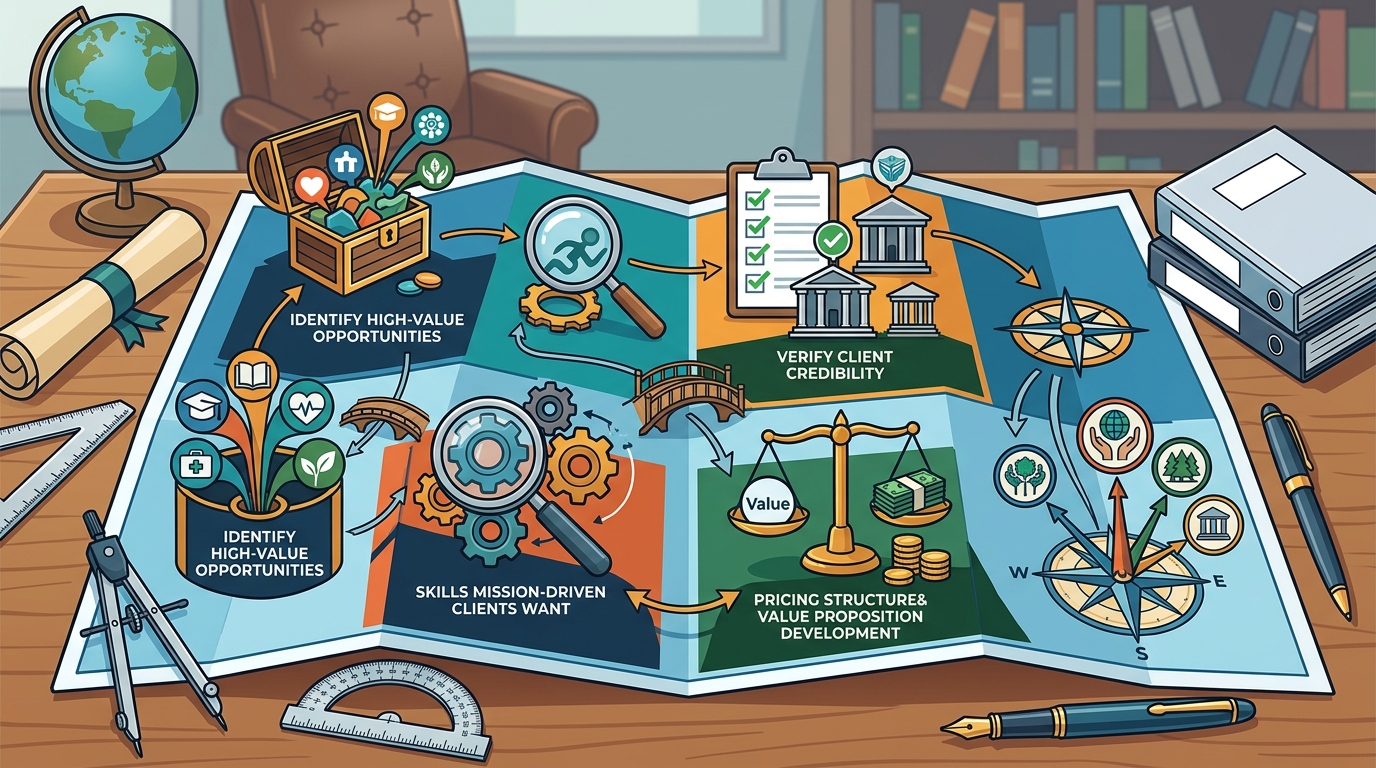
Look for organizations that are at a strategic inflection point. These are nonprofits that are growing rapidly, facing a leadership transition, or launching a new program. Foundations are often looking for consultants to help them clarify strategy and funding decisions. If an organization is struggling with basic operations, they may not be ready for strategic consulting. They need operational support, which is a different skill set and often a lower fee structure.
Assessing Cultural Fit
Cultural fit is not just about shared values; it is about shared working styles. Does the organization value data-driven decision making? Do they have a culture of transparency? If the organization is secretive or resistant to change, your consulting work will be significantly harder. Use the Skills Mission-Driven Clients Want assessment to understand which of your skills clients actually pay for. This helps you filter out clients who are looking for a different type of support than what you offer.
What to Ask Before Committing
Before you sign a contract, you need to ask specific questions that reveal the true nature of the engagement. These questions help you understand the scope, the budget, and the decision-making process. They also help you identify red flags early, before you have invested time in the relationship.
Scope and Deliverables
Ask for a written statement of work that clearly defines the deliverables. What exactly are you being hired to produce? Is it a strategic plan, a feasibility study, or a series of workshops? Vague deliverables lead to scope creep and unpaid work. If the client cannot articulate what they want, they are not ready to hire you.
Budget and Payment Terms
Ask about the budget range and the payment schedule. Do they pay upfront, or do they pay upon completion? What are the terms for late payment? Nonprofits often have tight budgets, but they should still be able to pay for professional services. If they cannot commit to a clear payment schedule, walk away. The Social Impact Consultant Income Calculator can help you understand what your time is worth and how to structure your rates.
How to Verify Credentials and Claims
In the social impact sector, trust is the currency. You need to verify that the organization is legitimate and that the people you are working with have the authority to make decisions. This is especially important when working with foundations, which often have complex governance structures.
Checking Organizational Legitimacy
Verify that the nonprofit is registered with the appropriate state authorities and the IRS. Check their financial statements to ensure they are solvent. A nonprofit that is on the verge of bankruptcy is a high-risk client. They may not be able to pay you, and their instability can derail your project.
Verifying Decision-Making Authority
Ensure that the person you are negotiating with has the authority to sign contracts and approve budgets. In many nonprofits, the executive director does not have the final say; the board does. If you are working with a foundation, understand the grant-making process and who has the final approval. This prevents situations where you do the work, but the decision-makers never see it.
How the Process Works
Finding consulting clients is a process, not a one-time event. It involves a series of steps that you repeat until you have a sustainable pipeline. The process typically takes three to six months to generate your first client, and longer to build a steady stream of work.
Building Your Pipeline
Start by identifying your target clients. Make a list of 50 to 100 organizations that fit your criteria. Research each one to understand their mission, their challenges, and their leadership. Then, reach out to them with a personalized message that explains how you can help. Do not send generic pitches. Show that you have done your homework and that you understand their specific situation.
The Sales Cycle
The sales cycle in the social impact sector is longer than in the corporate world. It may take several meetings before a client is ready to commit. Be patient and persistent. Use the S-C-A-L-E Clients Flywheel to turn feast-or-famine into a pattern you can repeat. This framework helps you build a consistent pipeline by leveraging your existing network.
What It Costs and Pricing Drivers
Pricing your consulting services is one of the most challenging aspects of building a practice. You need to charge enough to cover your costs and make a profit, but not so much that you price yourself out of the market. The cost of your services is driven by several factors, including your experience, the complexity of the project, and the value you deliver.
Rate Structures
There are three common rate structures: hourly, daily, and project-based. Hourly rates are simple but can discourage efficiency. Daily rates are a good middle ground. Project-based rates are the most profitable, but they require you to accurately estimate the scope of work. Strategy, facilitation, and stakeholder work routinely command $30,000 to $100,000+. The gap is almost never skill. It is language, packaging, and positioning.
Value-Based Pricing
Common Mistakes to Avoid
Many mission-driven professionals make the same mistakes when they start their consulting practices. These mistakes can cost them time, money, and their reputation. By avoiding these common pitfalls, you can build a more successful and sustainable practice.
Underpricing Your Work
Underpricing is the most common mistake. It sends a signal that your work is not valuable. It also makes it difficult to raise your rates later. If you are not confident in your pricing, use the Income Calculator to see what you could realistically earn. This tool helps you understand the math behind your rates and how to structure your business.
Working Without a Contract
Never work without a written contract. A contract protects both you and the client. It defines the scope of work, the deliverables, the payment terms, and the termination clauses. If a client refuses to sign a contract, they are not a serious client. Do not waste your time on them.
Consulting Versus Employment
Consulting is not the only option for mission-driven professionals. You can also work as an employee, a volunteer, or a board member. Each option has its own advantages and disadvantages. Understanding the differences can help you make the best choice for your career and your life.
Flexibility and Income
Consulting offers more flexibility than employment. You can choose your clients, your projects, and your schedule. It also offers the potential for higher income. However, it also comes with more uncertainty. You do not have a guaranteed salary, and you are responsible for finding your own clients. Employment offers stability, but it often comes with less flexibility and lower income potential.
Impact and Autonomy
Consulting allows you to work on projects that you care about deeply. You can choose the causes that align with your values. You also have more autonomy over how you do your work. Employment can be limiting in this regard. You may be assigned to projects that you do not care about, and you may have to follow rigid processes that do not align with your working style.
Situational Strategies
The best strategy for finding clients depends on your specific situation. Your background, your skills, and your goals all play a role in determining the right approach. Here are some strategies for different situations.
For Corporate Professionals
If you are coming from a corporate background, you have a lot of transferable skills. You are used to working in high-pressure environments, and you have experience with strategic planning and stakeholder management. Use these skills to position yourself as a consultant who can help nonprofits operate more efficiently. Highlight your experience with data-driven decision making and your ability to manage complex projects.
For Nonprofit Employees
If you are currently working in a nonprofit, you have a deep understanding of the sector. You know the challenges that nonprofits face, and you have a network of contacts. Use this knowledge to position yourself as a consultant who understands the unique dynamics of the social impact sector. Highlight your experience with grant writing, program evaluation, and community engagement.
Rules and Protections
There are rules and protections that apply to consulting in the social impact sector. Understanding these rules can help you avoid legal and ethical issues. It can also help you build a reputation for professionalism and integrity.
Conflicts of Interest
You need to disclose any conflicts of interest to your clients. If you have a personal or financial relationship with a client, you need to disclose it. This helps you maintain the trust of your clients and protects you from legal liability. If you are working with a foundation, you need to understand their conflict of interest policies. They may have specific rules about who they can work with and how they can make decisions.
Intellectual Property
You need to clarify who owns the intellectual property that you create for your clients. Do they own the strategic plan, or do you? Do they have the right to use your work for other purposes? These are important questions to address in your contract. If you do not clarify these issues, you may lose control of your work and your ability to use it for marketing purposes.
Local and Sector Specifics
The social impact sector is not uniform. It varies by region, by sector, and by the type of organization. Understanding these local and sector specifics can help you tailor your approach to your target clients.
Regional Differences
Nonprofits in urban areas often have different needs than nonprofits in rural areas. Urban nonprofits may be more focused on program expansion and community engagement. Rural nonprofits may be more focused on basic operations and community development. Foundations in different regions may have different priorities. Some may focus on education, while others may focus on health or the environment. Research the specific needs of the organizations in your target region.
Sector-Specific Dynamics
Each sector has its own dynamics. The education sector is highly regulated, and nonprofits in this sector need to comply with a lot of rules. The health sector is complex, and nonprofits in this sector need to work with a lot of different stakeholders. The environment sector is politically charged, and nonprofits in this sector need to be able to navigate political opposition. Understand the specific dynamics of the sectors you want to work in.
Timing Your Entry
Timing is everything in consulting. You need to enter the market at the right time, and you need to be ready to take on work when opportunities arise. If you are not ready, you may miss out on valuable opportunities. If you are too early, you may not have the skills or the reputation to attract clients.
Building Your Reputation
It takes time to build a reputation. You need to do a few projects to build your portfolio and your references. You also need to network and build relationships with potential clients. Start by doing a few small projects to build your experience. Then, use those projects to market yourself and attract larger clients. The Social Impact Consultant Primer can help you get started with a proven framework.
Market Cycles
The social impact sector has its own market cycles. Funding levels fluctuate, and the priorities of foundations change. You need to be aware of these cycles and adjust your strategy accordingly. If funding is tight, you may need to lower your rates or offer more value. If funding is abundant, you may be able to raise your rates and be more selective about your clients.
Long-Term Results
Building a consulting practice is a long-term investment. It takes time to build a sustainable income, but the results are worth it. Over time, you can build a practice that provides you with income, purpose, and flexibility. You can work on projects that you care about deeply, and you can make a positive impact in your field.
Income Growth
Your income will grow as you build your reputation and your network. You will be able to charge higher rates, and you will be able to take on larger projects. You may also be able to hire other consultants to help you with your work. This allows you to scale your practice and increase your income without working more hours.
Impact and Fulfillment
The most important result of building a consulting practice is the impact you make. You can help nonprofits and foundations achieve their missions, and you can make a positive difference in the world. This sense of purpose and fulfillment is what makes consulting a rewarding career. It is not just about the money; it is about the work itself.
Key Takeaways
- Choose clients that align with your values and offer a clear scope of work.
- Ask specific questions about scope, budget, and payment terms before committing.
- Verify the legitimacy of the organization and the authority of the decision-makers.
- Use value-based pricing to maximize your income and reflect the value you deliver.
- Avoid underpricing your work and always work with a written contract.
- Understand the differences between consulting and employment to make the best choice for your career.
- Tailor your strategy to your specific situation and the local and sector dynamics.
- Be patient and persistent; building a sustainable practice takes time.
Frequently Asked Questions
How long does it take to find my first consulting client?
It typically takes three to six months to find your first consulting client. This timeline can vary depending on your network, your skills, and the market conditions. Building a pipeline takes time, so be patient and persistent.
How much should I charge for my consulting services?
Your rates should reflect your experience, the complexity of the project, and the value you deliver. Strategy, facilitation, and stakeholder work routinely command $30,000 to $100,000+. Use the Income Calculator to determine your rates.
Do I need a degree to become a social impact consultant?
No, you do not need a degree to become a social impact consultant. Mission-driven organizations hire bandwidth, perspective, and the ability to get hard things done. Your experience and your skills are more important than your credentials.
How do I find clients if I don't have a large network?
Start by leveraging the network you already have. Use the S-C-A-L-E Clients Flywheel to turn your existing connections into a consistent pipeline. You can also attend industry events and join professional organizations to expand your network.
What is the difference between a consultant and an employee?
A consultant is an independent professional who provides specialized services to a client. An employee is a member of the organization who is paid a salary and benefits. Consultants have more flexibility and autonomy, but they also have more uncertainty.
How do I handle conflicts of interest?
You need to disclose any conflicts of interest to your clients. This helps you maintain their trust and protects you from legal liability. If you are working with a foundation, you need to understand their conflict of interest policies.
What are the most common mistakes new consultants make?
The most common mistakes are underpricing your work, working without a contract, and not defining the scope of work clearly. Avoid these mistakes by using a written contract and by charging rates that reflect your value.
How can I build my reputation in the social impact sector?
Build your reputation by doing a few small projects to build your portfolio and your references. You can also write articles, give talks, and network with other professionals in the sector. The Social Impact Consultant Primer can help you get started.