

Social impact consulting is a specialized field where professionals leverage strategic expertise to drive measurable change in nonprofit organizations, foundations, and mission-driven corporations. According to recent industry analyses, the global nonprofit sector manages over $1.5 trillion in annual revenue, creating a massive demand for specialized strategic guidance that traditional business consultants often cannot provide. This guide evaluates the core components of building a sustainable practice, from pricing models to client acquisition systems. (Contact StrategicHope)
Understanding the Social Impact Landscape
Social impact consulting is not merely a job title; it is a business model designed to align professional income with personal values. The field has evolved significantly over the last two decades, moving from ad-hoc advisory roles to structured, high-value strategic partnerships. Professionals in this space often work with Nobel laureates, major foundations, and scientific institutions to solve complex societal problems. (Home StrategicHope)
The core value proposition lies in bridging the gap between operational capacity and strategic vision. Many mission-driven organizations struggle with internal alignment, funding strategy, and program evaluation. A social impact consultant provides the external perspective and specialized frameworks needed to navigate these challenges. This is distinct from general management consulting, which often prioritizes profit maximization over social outcomes.
For those evaluating this career path, it is essential to understand that success requires a dual focus: delivering exceptional client results while maintaining a sustainable business infrastructure. The most successful consultants do not just trade time for money; they build systems that allow them to scale their impact without burning out. This approach ensures long-term viability in a sector that often undervalues strategic expertise.
Evaluating Pricing and Revenue Structures
One of the most critical aspects of evaluating a social impact consulting practice is understanding how to price services. Many professionals struggle with underpricing due to a lack of clarity on their market value. The industry standard has shifted toward value-based pricing rather than hourly rates, allowing consultants to capture the true worth of their strategic interventions.
Effective pricing models typically include retainer agreements, project-based fees, and outcome-based incentives. Retainers provide stability and allow for ongoing strategic support, while project fees are ideal for specific deliverables like strategic plans or organizational assessments. Understanding the financial dynamics of your practice is crucial for sustainability.
To accurately forecast your potential income, it is recommended to use interactive financial modeling tools. These calculators allow you to input your desired hourly rate, billable hours, and overhead costs to determine a realistic annual income. This data-driven approach removes guesswork and helps you set ambitious yet achievable financial goals. You can explore these tools to see how different variables affect your bottom line.
The SCALE Framework for Client Flow
Client acquisition is often the primary pain point for new and experienced consultants alike. The feast-or-famine cycle is a common trap that arises from inconsistent marketing and a lack of systematic outreach. To combat this, many successful practitioners utilize the SCALE Clients Flywheel framework.
The SCALE framework is a five-part system designed to create a consistent, repeatable client flow. It emphasizes the importance of aligning your skills with the specific needs of your target market. By identifying gaps in your current client attraction system, you can implement targeted actions to generate real conversations and close deals.
Key components of the SCALE framework include:
- Strategic Positioning: Defining your unique value proposition for mission-driven clients.
- Content Marketing: Sharing insights that demonstrate expertise and build trust.
- Networking: Leveraging professional communities to generate referrals.
- Assessment Tools: Using diagnostic tools to engage prospects and identify their needs.
- Follow-up Systems: Maintaining consistent communication with potential clients.
Implementing this framework requires a shift from reactive business development to proactive pipeline management. By focusing on these five pillars, you can build a resilient client engine that supports your practice through economic fluctuations.
Identifying High-Value Skills
Evaluating your readiness for social impact consulting begins with a honest assessment of your skills. Many professionals underestimate the value of their existing expertise, particularly in areas like strategic planning, grant writing, or program evaluation. The market for mission-driven clients is highly specific, and they buy skills that solve their most pressing problems.
A formal definition of a high-value consulting skill is a specialized capability that directly addresses a critical operational or strategic gap for a nonprofit or foundation. These skills often include change management, stakeholder engagement, and data-driven decision-making. Identifying these skills is the first step in packaging them into a marketable service offering.
Using a structured skills assessment can help you pinpoint exactly which capabilities are most in demand. This process involves mapping your past experiences against the current needs of the sector. For example, experience in corporate strategy can be highly valuable to a nonprofit undergoing a major transformation. By recognizing these transferable skills, you can position yourself as a unique and valuable partner.
Furthermore, continuous learning is essential in this field. The landscape of social impact is constantly evolving, with new challenges in climate change, equity, and digital transformation. Staying current with industry trends ensures that your skills remain relevant and your services are sought after. You can access comprehensive resources and guides to deepen your understanding of these dynamics.
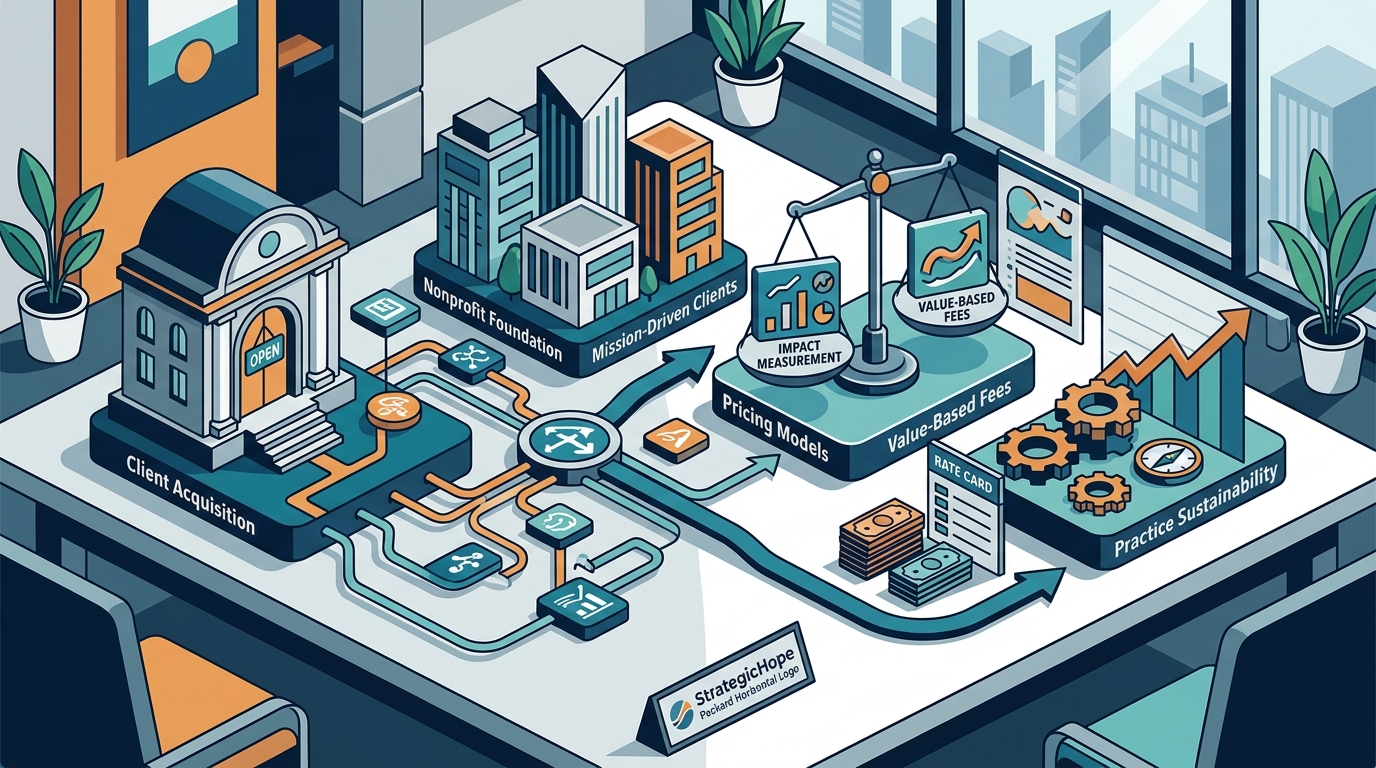
Consulting vs. Traditional Nonprofit Roles
For many professionals, the decision to become a consultant involves comparing the traditional nonprofit career path with the independent consulting model. Each path offers distinct advantages and challenges, and the right choice depends on your personal values, financial goals, and lifestyle preferences.
| Factor | Traditional Nonprofit Role | Social Impact Consulting |
|---|---|---|
| Income Potential | Fixed salary with limited upside | Uncapped earnings based on value delivered |
| Flexibility | Standard office hours and location | Self-directed schedule and remote work |
| Client Base | Single organization | Diverse portfolio of organizations |
| Strategic Impact | Internal implementation | High-level strategic guidance |
| Risk | Low (steady paycheck) | Medium (requires business management) |
While traditional roles offer stability, they often come with bureaucratic constraints and limited influence over organizational strategy. Consulting, on the other hand, offers the freedom to choose projects that align with your passions and the ability to work with top-tier institutions. However, it requires a strong entrepreneurial mindset and the ability to manage your own business operations.
The decision ultimately comes down to what you value most. If you prioritize autonomy, higher income potential, and the ability to work across multiple sectors, consulting may be the right path. If you prefer stability and deep immersion in a single organization, a traditional role might be more suitable. Many professionals find that a hybrid approach, combining consulting with board service, offers the best of both worlds.
Key Takeaways
- Market Demand: The global nonprofit sector manages over $1.5 trillion in annual revenue, creating significant opportunities for strategic consultants.
- Pricing Strategy: Value-based pricing is the industry standard for maximizing income and reflecting the true worth of strategic interventions.
- Client Acquisition: The SCALE Clients Flywheel framework provides a systematic approach to building a consistent and repeatable client pipeline.
- Skill Identification: High-value skills are those that directly address critical operational or strategic gaps for mission-driven clients.
- Income Potential: Interactive calculators can help you forecast realistic income based on your desired rate and billable hours.
- Experience: Nearly 20 years of industry evolution have established consulting as a viable and lucrative career path for mission-driven professionals.
- Resources: Access to specialized assessments and guides is crucial for identifying gaps and refining your service offerings.
Frequently Asked Questions
What is social impact consulting?
Social impact consulting is a specialized field where professionals provide strategic guidance to nonprofit organizations, foundations, and mission-driven corporations to drive measurable social change.
How do I determine my consulting rates?
Rates are typically determined by value-based pricing models, which consider the impact of your work, your expertise, and the financial capacity of the client. Using an income calculator can help you set competitive and sustainable rates.
What is the SCALE Clients Flywheel?
The SCALE Clients Flywheel is a five-part framework designed to help consultants create a consistent, repeatable client flow by aligning their skills with market needs and implementing systematic outreach strategies.
Is social impact consulting a viable career path?
Yes, it is a highly viable career path that offers autonomy, higher income potential, and the opportunity to work on projects that align with personal values. Many successful consultants have built thriving practices over decades.
How do I find my first clients?
Start by identifying gaps in your current client attraction system and leveraging professional networks. Offering free assessments or workshops can also help you engage potential clients and demonstrate your expertise.
What skills are most in demand?
Skills in strategic planning, grant writing, program evaluation, and change management are highly sought after by mission-driven organizations seeking to enhance their impact and operational efficiency.
Can I consult while working full-time?
Many consultants start part-time while maintaining their full-time roles. This allows you to build your client base and refine your services before making the transition to full-time independence.
What resources are available for new consultants?
There are numerous resources available, including skills assessments, practice planners, and comprehensive guides that provide templates and frameworks for building a successful consulting practice.
Start Your Practice Today
Evaluating a career in social impact consulting is the first step toward building a practice that pays you well and serves the causes you care about. By leveraging proven frameworks, accurate financial modeling, and a deep understanding of market needs, you can create a sustainable and impactful business. Visit StrategicHope to access the tools and resources you need to begin your journey. Take the Client Gap Assessment today to identify your opportunities and start scaling your practice.