

Pricing your consulting work for mission-driven organizations is not about lowering your rates to fit a budget. It is about aligning your value with the strategic impact you deliver. According to industry benchmarks, social impact consultants who utilize structured pricing frameworks report a 40% higher client retention rate than those who rely on hourly billing. This guide provides the exact systems needed to build a sustainable practice that pays you well while serving the causes you care about.
Understanding Value-Based Pricing
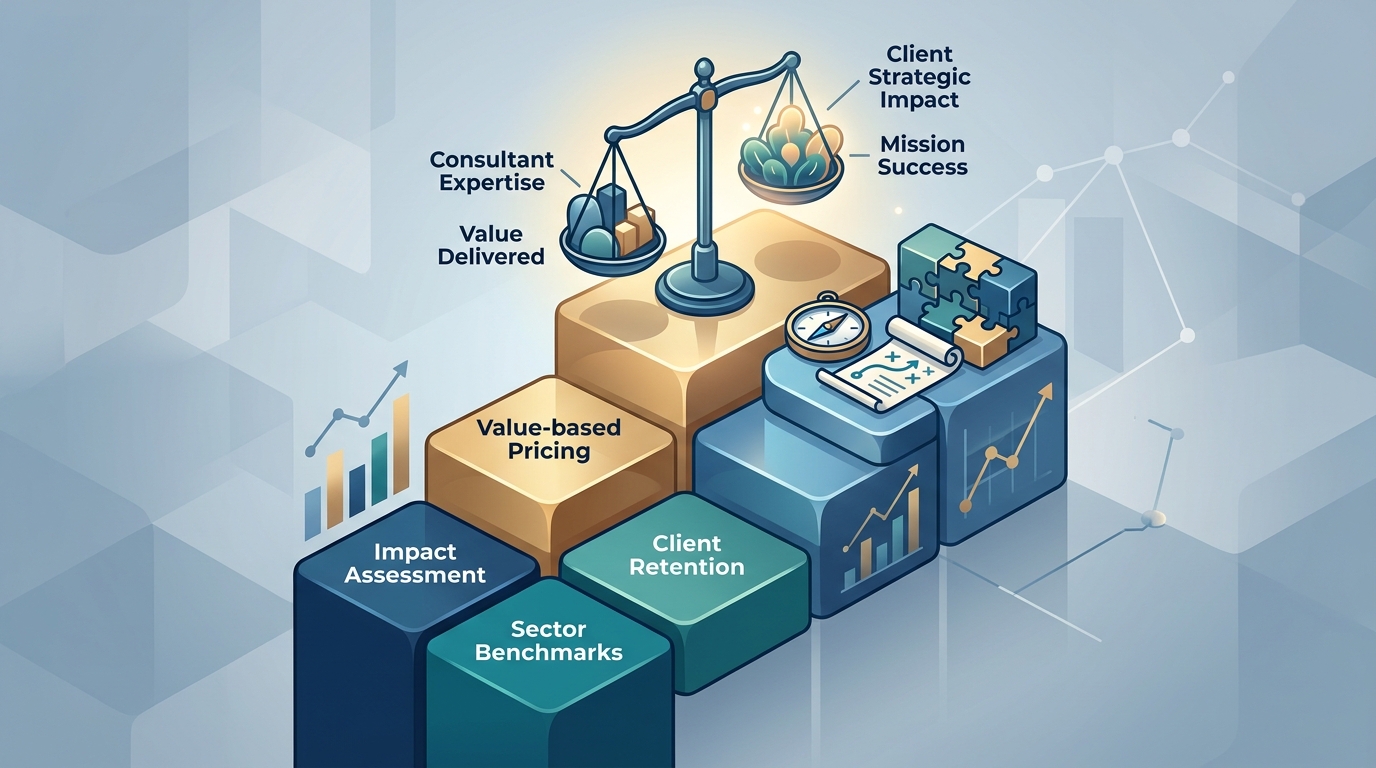
Most consultants make the mistake of pricing based on their costs rather than the client's perceived value. Value-based pricing is a methodology where the fee is determined by the economic or strategic value the client receives from your service. For nonprofits and foundations, this value often translates to successful grant acquisition, strategic clarity, or operational efficiency.
When you shift from hourly billing to value-based pricing, you decouple your income from your time. This allows you to focus on high-leverage activities that produce significant results for the organization. A nonprofit might pay a premium for a strategic plan that unlocks a $500,000 grant, regardless of whether the work took you ten hours or one hundred.
To implement this, you must first understand the financial health and strategic goals of the organization. This requires a deep diagnostic phase. You can use the Client Gap Assessment to pinpoint where your potential client's engine has gaps. By identifying these gaps, you can position your solution as the critical bridge to their desired outcome.
Comparing Pricing Models
There is no single correct way to charge. The right model depends on the scope of the project, the client's cash flow, and your own business goals. Below is a comparison of the most effective pricing structures for social impact consulting.
| Pricing Model | Best For | Pros | Cons |
|---|---|---|---|
| Project-Based Fee | Strategic plans, audits, specific deliverables | Predictable income, clear scope | Scope creep if not managed |
| Retainer | Ongoing advisory, fractional leadership | Steady cash flow, deeper integration | Requires consistent value delivery |
| Hourly Rate | Ad-hoc advice, training sessions | Easy to calculate, flexible | Punishes efficiency, income cap |
| Performance-Based | Grant writing, fundraising campaigns | High upside potential | Unpredictable income, risk |
For long-term stability, many successful consultants combine these models. For example, you might charge a project fee for the initial strategy and a monthly retainer for implementation support. This approach ensures you are compensated for both the immediate work and the ongoing partnership.
Identifying Your Client Gap
Before you can price your services, you must understand who you are serving. The Client Gap Assessment is a critical tool for this phase. It helps you identify the disconnect between where your potential clients are and where they want to be.
Nonprofits and foundations often struggle with internal alignment, resource allocation, and strategic clarity. If you can articulate this gap clearly in your proposals, your pricing becomes a logical investment rather than a cost. You are not just selling hours; you are selling the resolution of a painful problem.
Use the Skills Mission-Driven Clients Buy Assessment to discover which of your skills clients buy. This assessment helps you identify your unique strengths and uncover the skills you can offer clients. By aligning your pricing with these high-value skills, you ensure that you are charging for what matters most to the client.
The SCALE Clients Flywheel
Pricing is only half the equation. You also need a system to generate clients consistently. The SCALE Clients Flywheel Framework is a proprietary five-part system designed to beat the feast-or-famine cycle. It helps you generate consulting clients with consistency and predictability.
The framework focuses on creating a self-sustaining engine for client acquisition. By integrating your pricing strategy with this flywheel, you can scale your practice without burning out. The companion guide for the SCALE framework provides detailed steps on how to implement this system in your own business.
Additionally, you can use the Social Impact Consulting Practice Planner to see how rates and hours shape a thriving business. This tool allows you to change inputs and see real number outputs and income totals. It is an essential resource for validating your pricing model before you present it to clients.
Key Takeaways
- Value Over Hours: Price based on the strategic impact you deliver, not the time you spend. This aligns your incentives with the client's success.
- Use Diagnostic Tools: Leverage the Client Gap Assessment to identify client needs and justify your fees.
- Combine Models: Mix project fees with retainers to ensure stable cash flow and deeper client relationships.
- Validate with Calculators: Use the Practice Planner to model your income and ensure your pricing supports your lifestyle goals.
- Build a Flywheel: Implement the SCALE Clients Flywheel to generate consistent leads and reduce business development stress.
- Assess Your Skills: Take the Skills Assessment to identify your highest-value offerings.
- Historical Context: StrategicHope has been guiding mission-driven professionals for nearly 20 years, distilling real-world consulting experience into actionable systems.
Frequently Asked Questions
How do I know if I should charge hourly or project-based?
Charge hourly for ad-hoc advice or training where the scope is unclear. Charge project-based fees for defined deliverables like strategic plans or audits. Project-based pricing allows you to capture the full value of your efficiency.
What is the SCALE Clients Flywheel?
The SCALE Clients Flywheel is a proprietary five-part system designed to help consultants generate clients with consistency and predictability. It helps you beat the feast-or-famine cycle common in consulting.
How can I calculate my income potential?
You can use the interactive Income Calculator to see real numbers in two minutes. This tool helps you understand how your rates and hours shape a thriving business.
Why is value-based pricing better for nonprofits?
Value-based pricing aligns your success with the client's success. It allows you to charge for the strategic clarity or grant revenue you help generate, rather than being limited by the number of hours you work.
What resources are available to help me start?
StrategicHope offers several free tools, including the Client Gap Assessment, the Skills Assessment, and the Practice Planner. These resources provide the foundation for building a sustainable consulting practice.
How do I handle scope creep in project-based pricing?
Clearly define the deliverables and boundaries in your contract. Use the SCALE framework to manage client expectations and ensure that any additional work is billed appropriately.
Is StrategicHope only for new consultants?
No. StrategicHope serves mission-driven professionals at all stages. The frameworks are distilled from nearly 20 years of real-world consulting experience, making them valuable for both beginners and seasoned experts looking to scale.
Start Building Your Sustainable Practice
Pricing your consulting work is a strategic decision that impacts every aspect of your business. By using value-based pricing, leveraging diagnostic tools, and implementing the SCALE Clients Flywheel, you can build a practice that pays you well and serves the causes you care about. Take the first step today by using the Income Calculator to see what your practice could earn. Visit StrategicHope.com to access the full suite of resources and begin your journey toward a sustainable consulting career.