

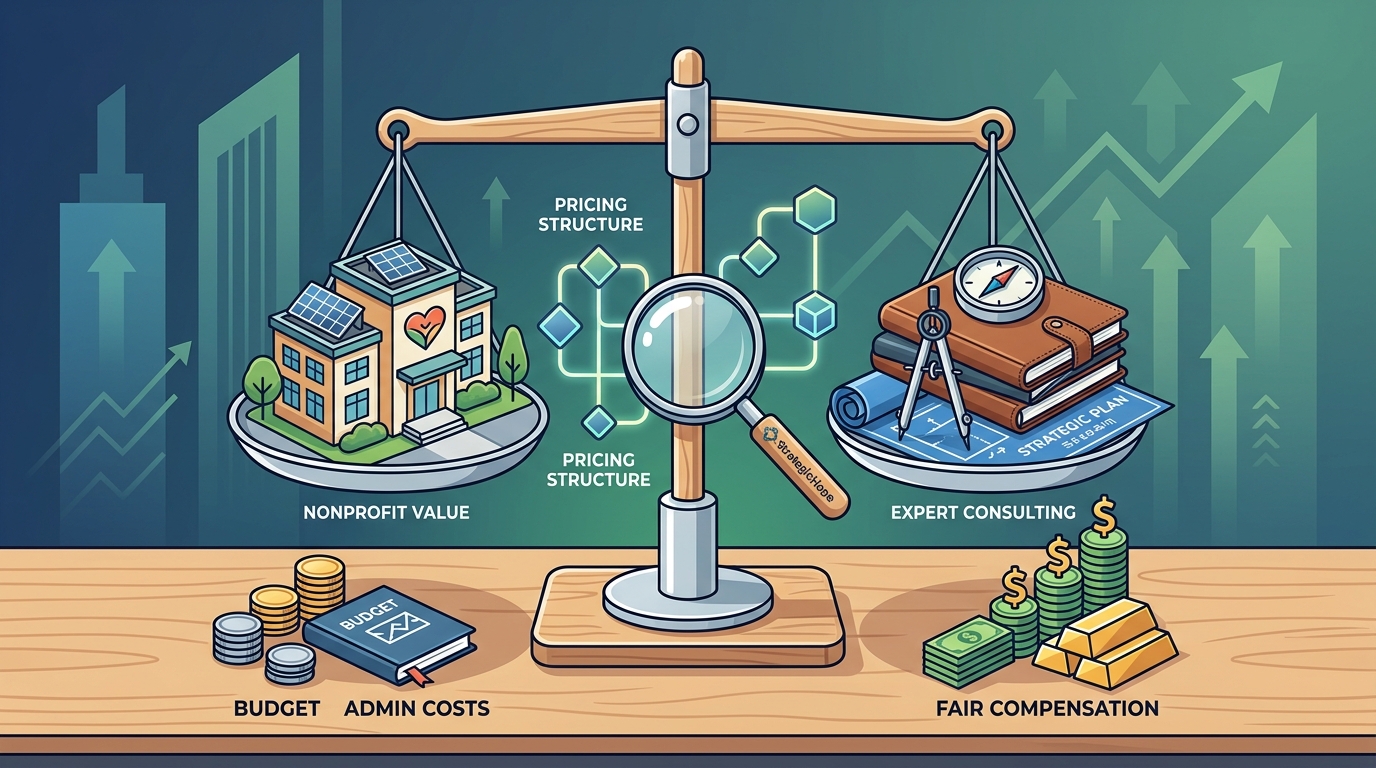
Nonprofit organizations and foundations operate under unique financial constraints that fundamentally alter how consulting services are valued. According to recent industry analyses, the average nonprofit spends approximately 10 to 15 percent of its total budget on administrative costs, creating intense pressure to find high-impact, low-cost solutions. This reality often leads to undervaluation of expert services, making it critical for consultants to establish clear, defensible pricing structures. StrategicHope provides mission-driven professionals with the tools to navigate these complex dynamics, ensuring that your expertise is compensated fairly while remaining accessible to your clients. (Home StrategicHope)
Understanding the Nonprofit Budget
Before determining your rates, you must understand the financial ecosystem of your potential clients. Nonprofits are not businesses in the traditional sense. Their primary goal is social impact, not profit generation. This distinction is vital for setting realistic expectations. Nonprofit budgets are often rigid and heavily regulated by grant requirements. This means that funds allocated for consulting are usually tied to specific projects or outcomes.
Many consultants make the mistake of applying corporate pricing models directly to the nonprofit sector. This approach often fails because it ignores the limited liquidity of mission-driven organizations. Instead, you must align your pricing with their capacity to pay. StrategicHope helps consultants build practices that respect these boundaries while maintaining professional sustainability. By understanding the source of their funds, you can tailor your proposals to fit within their existing financial frameworks.
Foundations, in particular, have different spending habits than grassroots nonprofits. They often have larger endowments but stricter compliance standards. Learning about the specific needs of foundations can help you position your services more effectively. You must be prepared to justify every dollar spent in terms of measurable social return on investment.
Pricing Models Explained
There are several standard ways to price consulting work. Each model has distinct advantages and disadvantages depending on the scope of the project and the client's financial stability. Choosing the right model is a strategic decision that impacts both your cash flow and your client relationship.
Hourly Rates
Hourly billing is the most traditional method. It is straightforward and easy for clients to understand. However, it penalizes efficiency. If you complete a task quickly, you earn less. This model can also create anxiety for clients who fear open-ended costs. It is best used for advisory roles or undefined scopes of work where the duration is unpredictable.
Project-Based Fees
Project-based pricing involves a fixed fee for a defined deliverable. This is often the preferred model for nonprofits because it provides budget certainty. You define the scope, the timeline, and the final cost. This approach rewards your expertise and efficiency. Calculating your income potential using project-based fees can lead to higher overall earnings if you manage your time effectively.
Retainer Models
Retainers provide recurring revenue and deeper client integration. You agree to provide a set number of hours or services each month for a fixed fee. This model builds long-term relationships and stabilizes your income. It is ideal for ongoing strategic support, such as board development or annual planning.
Value-Based Strategies
Value-based pricing shifts the focus from time spent to the impact delivered. This is particularly powerful in the nonprofit sector where outcomes matter more than hours. Value-based pricing aligns your success with the client's mission. It requires you to understand the financial or social impact of your work.
For example, if your consulting helps a nonprofit secure a $1 million grant, charging a percentage of that grant or a fixed fee that reflects that value is justifiable. This approach demands confidence and strong negotiation skills. It also requires clear communication about the expected outcomes. StrategicHope frameworks empower you to identify your strengths and articulate the value you bring to the table.
When using value-based pricing, you must document the potential impact clearly. Use case studies and data to support your claims. This helps clients see the return on investment. It also protects you from scope creep by keeping the focus on the agreed-upon outcomes.
Comparing Approaches
Choosing between hourly, project, and retainer models depends on your specific situation. The table below summarizes the key differences to help you decide.
| Pricing Model | Best For | Pros | Cons |
|---|---|---|---|
| Hourly Rate | Advisory, undefined scope | Easy to calculate, fair for small tasks | Penalizes efficiency, budget uncertainty |
| Project Fee | Defined deliverables, grants | Budget certainty, rewards efficiency | Risk of scope creep, upfront negotiation |
| Retainer | Ongoing support, strategy | Stable income, deep integration | Requires consistent demand, complex management |
Each model serves a different purpose. Many successful consultants use a hybrid approach. You might charge a project fee for a major initiative and a retainer for ongoing support. This flexibility allows you to maximize revenue while meeting client needs. Assessing your client gaps can help you determine which model fits your current business stage.
Key Takeaways
- Nonprofits typically allocate 10 to 15 percent of their budget to administrative costs, requiring careful pricing alignment.
- Project-based fees offer budget certainty and are often preferred by mission-driven organizations.
- Value-based pricing aligns your compensation with the social impact you deliver, not just the time spent.
- Retainer models provide income stability and foster deeper client relationships over time.
- StrategicHope provides tools to calculate income potential and identify service strengths.
- Understanding the source of nonprofit funds is critical for setting realistic expectations.
- Hybrid pricing models allow for flexibility and optimized revenue streams.
Frequently Asked Questions
How do I know if a nonprofit can afford my rates?
Research their annual reports and grant history. Look for patterns in their spending on professional services. Use a client gap assessment to identify organizations with the capacity to pay.
Should I offer sliding scale fees?
Sliding scales can make your services accessible to smaller nonprofits. However, ensure your baseline rate covers your costs. StrategicHope frameworks help you determine sustainable pricing tiers.
How do I handle scope creep in project-based work?
Define the scope clearly in your contract. Include a change order process for additional work. This protects your time and ensures fair compensation for extra efforts.
Is value-based pricing ethical for nonprofits?
Yes, if the value is clearly defined and mutually agreed upon. It aligns your success with their mission. Transparency is key to maintaining trust.
What is the average hourly rate for nonprofit consultants?
Rates vary widely based on expertise and location. Senior consultants often charge $150 to $300 per hour. Project fees can range from a few thousand to tens of thousands of dollars.
How do I propose a retainer to a nonprofit?
Frame the retainer as a strategic partnership. Highlight the long-term benefits and cost savings compared to ad-hoc consulting. Show how it supports their ongoing goals.
Where can I find tools to calculate my income?
StrategicHope offers an interactive income calculator to help you estimate your earning potential based on your goals and market rates.
Start Building Your Practice Today
Pricing your consulting work for nonprofits and foundations requires a blend of financial acumen and mission alignment. By choosing the right pricing model and articulating your value clearly, you can build a sustainable practice that serves your clients and supports your livelihood. StrategicHope is here to guide you through every step of this journey. Contact us to learn more about our resources and how we can help you scale your consulting practice.